There are currently 0 users and 0 guests online.
|
Geostatistical mapping can be defined as analytical production of maps by using field observations, auxiliary information and a computer program that generates predictions. The purpose of this guide is to assist you in producing quality maps by using fully-operational open source software packages: R+gstat/geoR and SAGA GIS. Materials presented in this book have been used for the five-day advanced training course "GEOSTAT: spatio-temporal data analysis with R+SAGA+Google Earth" that is periodically organized by the author and collaborators. This is an open access publication!
warning: Parameter 2 to gmap_gmap() expected to be a reference, value given in /home/spatiala/public_html/book/includes/module.inc on line 497.
GEOSTAT 2011 Summer School videos are available for download from the archive.org.
Introduction by Roger Bivand on Day 1 of the GEOSTAT 2011.
 This is an Open Access Publication which means that a digital copy of this book is freely available under the Creative Commons Attribution-Noncommercial-No Derivative Works 3.0. This is an Open Access Publication which means that a digital copy of this book is freely available under the Creative Commons Attribution-Noncommercial-No Derivative Works 3.0.
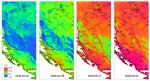
This figure is from:
Hengl, T., Heuvelink, G.B.M., Percec Tadic, M., Pebesma, E., 2011. "Spatio-temporal prediction of daily temperatures using time-series of MODIS LST images". Theoretical and Applied Climatology.
Download:
 It is my pleasure to inform you that the next GEOSTAT summer school will be held in the period 24-31 July 2011 at the Koblenz-Landau University. It is my pleasure to inform you that the next GEOSTAT summer school will be held in the period 24-31 July 2011 at the Koblenz-Landau University.
Next year a large international conference on spatial statistics will be held in Enschede, the Netherlands. For more info see: www.spatialstatisticsconference.com; I have been invited, together with a number of other open source enthusiasts, to talk about possibilities of combining statistics and geographical computing. Down-below is a short summary of my lecture.
Short title:
get GSOD data
Purpose and use:
Import, formating and binding of the Daily Global Weather Measurements, 1929-2009 (NCDC, GSOD)
Programming environment:
R / S language
Status of work:
Tested on a MS Windows machine only
Description of files available via the NCDC website. This is an extensive dataset and requires substantial storage and processing capacities - each station is saved in a separate directory and needs to be processed separately. The attached example shows temperature and precipitation measurements for 1st of May 2006.

|
"...Probably the only shared characteristic would be that these are things you can’t really get unmotivated people to grasp, but if someone is motivated, they’ll find their way in somehow. And enjoy it, after all, it is supposed to be fun, isn’t it?"
— Roger Bivand, Norwegian School of Economics and Business Administration
|


 | Contact: Tomislav Hengl ([email protected]) |
Recent comments
9 years 5 weeks ago
9 years 22 weeks ago
9 years 31 weeks ago
9 years 43 weeks ago